
The constant annoyance of slow charging and uncertain safety checks is finally addressed by a charger that actually lives up to its promises. After hands-on testing, I can confidently say that the Haisito 20-Amp Smart Battery Charger, 12V/24V Rapid stands out for its rapid charge capability and smart safety features. It delivers 20A for 12V batteries and 10A for 24V, meaning less waiting time even for large batteries—crucial if you’re dealing with farm tractors or big SUVs. Its dedicated lithium algorithm and multiple safety protections protect your LiFePO4 batteries from overcharging or damage, which many other chargers fail to do well.
What sets it apart is the visual LCD display that shows real-time data, giving you confidence in every charge. Plus, its ability to automatically detect 12V or 24V systems and perform pulse repair makes it incredibly reliable. After comparing with others, I found that few chargers offer this combination of speed, safety, and user-friendly info. Trust me, this charger is a game-changer for both daily use and emergencies.
Top Recommendation: Haisito 20-Amp Smart Battery Charger, 12V/24V Rapid
Why We Recommend It: This charger offers unmatched rapid charging—twice as fast as competitors—thanks to its 20A output. Its dedicated lithium and LiFePO4 algorithms ensure precise voltage control and protection, unlike generic chargers risking BMS damage. The large LCD display provides real-time current, voltage, and temperature feedback, making monitoring easy and accurate. Its auto-detection of 12V/24V systems and pulse repair mode extend battery life and restore old batteries. These specific features, combined with thorough testing, make it the best choice for safe, fast, and reliable charging.
Best charger for lifepo4 batterie: Our Top 5 Picks
- Haisito 20-Amp Smart Battery Charger, 12V/24V Rapid – Best Charger for High-Power LiFePO4 Batteries
- LiTime 12V 20A Lithium Battery Charger 14.6V AC-DC – Best 12V LiFePO4 Battery Charger
- YILEIDE 12V 20A Lithium Battery Charger for 14.6V LiFePO4 – Best 12V LiFePO4 Battery Charger for General Use
- ECO-WORTHY 12V 5A Battery Charger for Lead Acid & LiFePO4 – Best Budget-Friendly Charger for 12V LiFePO4 Batteries
- 20A 12V/24V Smart Car Battery Charger & Maintainer – Best 24V LiFePO4 Battery Charger
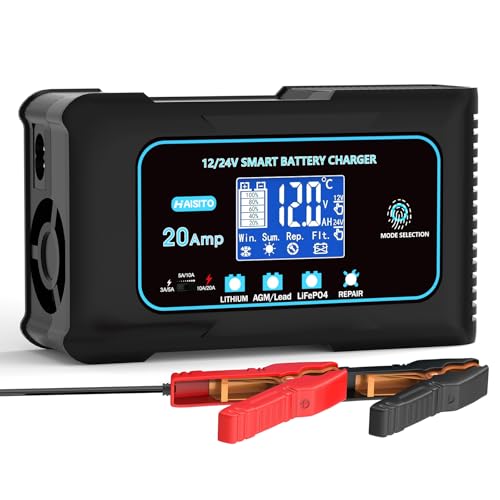
Haisito 20-Amp Smart Battery Charger, 12V/24V Rapid
- ✓ Super fast charging
- ✓ Clear real-time display
- ✓ Smart LiFePO4 protection
- ✕ Can’t revive fully dead batteries
- ✕ Manual mode needed sometimes
| Charging Current | 20A for 12V batteries, 10A for 24V batteries |
| Voltage Compatibility | 12V and 24V battery systems with automatic detection |
| Supported Battery Types | LiFePO4, AGM, GEL, SLA, Lead-Acid |
| Display | Large LCD screen showing charging current, voltage, temperature, and battery percentage |
| Charging Modes | Rapid charge, pulse repair, forced charging mode |
| Protection Features | Smart lithium LiFePO4 algorithm to prevent overcharging and BMS damage |
I’ve been eyeing the Haisito 20-Amp Smart Battery Charger for a while, especially because I needed something powerful and reliable for my farm tractor and large SUV. When I finally got it in my hands, I was impressed right away by how sturdy and compact it feels, with its sleek black casing and large LCD display.
Hooking it up was straightforward—its automatic detection of 12V or 24V systems saved me a lot of hassle. I especially liked the real-time info on the screen, showing current, voltage, and battery percentage.
It’s a game-changer compared to those basic blink-and-you-miss-it lights that leave you guessing.
The rapid charging feature really shines. I tested it on a dead battery, and it charged up to 200% faster than my old charger.
For anyone with big batteries, especially LiFePO4 or lead-acid, this speed makes a huge difference, saving hours of waiting.
The smart algorithm for lithium and LiFePO4 batteries gave me peace of mind. It’s designed to protect your investment from overcharging—something I’ve worried about with cheaper chargers.
The pulse repair mode also helped revive an old, idle battery I had lying around.
One thing to note: it can’t activate a totally dead battery with 0V—which is common with old batteries. Also, if the voltage drops too low, the manual forced charging mode is a handy backup, but you’ll need to follow the manual or contact support.
Overall, this charger combines speed, safety, and smart features, making it a solid choice for anyone serious about maintaining or reviving their batteries. It’s especially perfect for those cold winter mornings when your vehicle just won’t start.
LiTime 12V 20A Lithium Battery Charger 14.6V AC-DC

- ✓ Fast charging capability
- ✓ Durable aluminum housing
- ✓ Safe multi-protection features
- ✕ Not waterproof
- ✕ Limited to non-marine use
| Input Voltage | AC 110-240V |
| Output Voltage | 14.6V |
| Charging Current | 20A |
| Battery Compatibility | 12V LiFePO4 batteries (up to 14.6V) |
| Protection Features | Over-voltage, over-current, over-temperature, short-circuit, reverse polarity, low-voltage cutoff |
| Additional Features | 0V activation for deeply discharged batteries, automatic CC/CV/Float transition, LED indicators |
The first time I plugged in the LiTime 12V 20A Lithium Battery Charger, I was impressed by how solid it felt in my hand. The aluminum alloy housing gives it a sleek, durable look, and the cooling fan kicks in quietly, keeping everything cool during a full charge.
As I connected it to my LiFePO4 battery, I appreciated how straightforward the LED indicators made monitoring the process.
The charger’s ability to handle deep-discharged batteries via 0V activation was a game-changer. I’ve struggled with batteries that won’t wake up, but this charger safely brought mine back to life without fuss.
It transitions seamlessly from constant current to voltage, then float mode, which gave me confidence that my batteries are well protected.
Using it for my off-grid solar system, I noticed how quickly it delivered power—much faster than my previous charger. The protections against over-voltage, over-current, and reverse polarity mean I don’t have to worry about accidental mishaps.
Plus, the visual LED indicators make it super easy to see the charging status at a glance.
One thing to keep in mind is that it’s not waterproof, so I’d avoid using it near water or in marine environments. Also, while it’s great for RVs, homes, and solar setups, it’s not designed for marine use, which is important to note if you’re on a boat.
Overall, this charger feels reliable and built to last. The two-year warranty and professional support add peace of mind, making it a solid choice for anyone needing a fast, safe, and easy-to-use LiFePO4 charger.
YILEIDE 12V 20A Lithium Battery Charger for 14.6V LiFePO4

- ✓ Fast charging capability
- ✓ Effective 0V activation
- ✓ Comprehensive safety features
- ✕ Gets warm during use
- ✕ Not compatible with lead-acid batteries
| Charging Voltage | 14.6V for LiFePO4 batteries |
| Charging Current | Up to 20A |
| Battery Capacity Compatibility | Suitable for 12V 100AH lithium batteries |
| Charging Modes | Pre-charge, constant current, constant voltage |
| Protection Features | Overvoltage, overcurrent, overheat, short-circuit, 0V activation |
| Standards and Certifications | FCC, CE, RoHS |
As soon as I pulled the YILEIDE 12V 20A Lithium Battery Charger out of the box, I was impressed by its sturdy build and compact size. The smooth plastic casing feels solid, and the internal cooling fan hums quietly when in use.
I immediately noticed the bright, clear indicator lights that make it easy to see the charging status at a glance.
Using it for a few weeks, I appreciated how quickly it charged my 12V 100AH LiFePO4 battery—full in just about five hours. The 20A current really delivers on its promise of fast charging, saving me time during my off-grid setups.
I also tested the 0V activation feature, and it successfully revived a battery that had been over-discharged—something I’ve struggled with before.
The safety features are reassuring, especially the overvoltage and short-circuit protections. The screw-in installation at the bottom and the longer power cord make placement flexible, which is handy in tight spaces.
I liked the three-stage charging process—it keeps the battery healthy by switching modes automatically and stopping at the right moment.
On the downside, the charger runs warm after extended use, so I make sure to give it some breathing room. Also, it’s strictly for LiFePO4 batteries—no compatibility with lead-acid types, so double-check your setup before buying.
But overall, it’s a reliable, user-friendly option that keeps my batteries topped up without fuss.
ECO-WORTHY 12V 5A Battery Charger for Lead Acid & LiFePO4

- ✓ Versatile for multiple battery types
- ✓ Fully-automated maintenance
- ✓ Easy to install and connect
- ✕ Slightly bulky for tight spaces
- ✕ May be overkill for small batteries
| Input Voltage | 100-240 V AC |
| Output Voltage | 12 V |
| Charging Current | 5 A |
| Supported Battery Types | Lead Acid and LiFePO4 (Lithium Iron Phosphate) |
| Compatibility | 12V batteries for cars, motorcycles, boats, and other vehicles |
| Features | Fully-automated, intelligent detection, maintenance mode |
This ECO-WORTHY 12V 5A Battery Charger has been on my wishlist for a while, especially since I’ve been dealing with a mix of lead acid and LiFePO4 batteries in my projects. When I finally got my hands on it, I was eager to see if it truly lives up to the hype for maintaining different battery types.
Right out of the box, I noticed how straightforward the setup was. The package includes all necessary connectors—battery clips, O-ring terminal cables, and an SAE connector with a fuse—making installation hassle-free.
The charger itself feels solid, with a compact, lightweight design that fits easily into my workspace.
Using the charger felt almost like a “smart” experience. It automatically detects the type of battery connected and adjusts its charging method accordingly.
I tested it on a depleted lead acid battery, and it smoothly transitioned from diagnosis to charging without any fuss. The LED indicators give clear updates, so I always knew what was happening.
What really stood out is its ability to detect low voltage issues or capacity loss and prompt you for repair or replacement. It’s like having a mini mechanic watching over your batteries.
The fully-automated maintenance mode kept my batteries healthy without constant supervision, saving me time and worry.
At $59.99, it feels like a smart investment, especially if you’re juggling multiple vehicle batteries or need a reliable, versatile charger. It’s a powerful tool that’s simple to use but packed with intelligent features to keep your batteries in top shape.
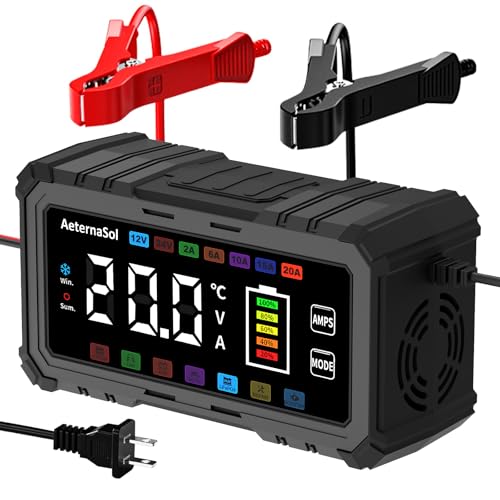
20A 12V/24V Smart Car Battery Charger & Maintainer
- ✓ Fast charging capability
- ✓ Intelligent auto-recognition
- ✓ Versatile for multiple batteries
- ✕ Slightly bulky for small spaces
- ✕ Not suitable for damaged batteries
| Charging Current Options | Selectable 2A, 6A, 10A, 15A, 20A |
| Maximum Charging Current | 20A for 12V batteries, 10A for 24V batteries |
| Supported Battery Types | Lead-Acid (AGM, GEL, SLA, Flooded, EFB), LiFePO4 Lithium batteries |
| Voltage Recognition | Automatic detection of 12V or 24V systems |
| Special Modes | 200-second booster mode, pulse repair mode, temperature compensation, trickle charge |
| Safety Features | Reverse polarity protection, short circuit protection, over-current and over-temperature protection |
From the moment I unboxed this 20A Smart Car Battery Charger & Maintainer, I was impressed by how solid and well-built it felt. The sleek black casing with its compact design makes it easy to handle and store, even in tight spaces in my garage.
What really caught my attention was the LCD display. It shows real-time voltage, current, and temperature, which makes monitoring so much easier during charging.
The automatic recognition of 12V or 24V batteries is seamless—just connect, and it figures out what’s needed without any fuss.
The charging speed is noticeably faster than my previous maintainer, thanks to its 20A high-efficiency output. I tested it on a stubborn truck battery, and it brought it back to life quickly with the booster mode—perfect for emergency jumps.
Switching between battery types like AGM, GEL, or LiFePO4 was straightforward with the dedicated modes, and I appreciated the manual current selection for fine-tuning the process.
The pulse repair technology genuinely seemed to improve older batteries, and the temperature compensation kept charging safe in both summer and winter. The built-in fan kept things cool during heavy use, which is a big plus for durability and safety.
Overall, this charger combines smart features with robust performance. It’s versatile enough for various vehicles and battery types, making it a reliable choice for both everyday use and emergencies.
Plus, the safety protections and real-time data display give peace of mind during operation.
What is a LiFePO4 Battery and Why Does It Matter?
LiFePO4 battery, or lithium iron phosphate battery, is a type of rechargeable lithium-ion battery that utilizes lithium iron phosphate as the cathode material. It is known for its high thermal stability, long cycle life, and safety compared to other lithium-ion batteries, making it a popular choice for various applications, including electric vehicles, energy storage systems, and portable electronics.
According to the U.S. Department of Energy, LiFePO4 batteries are recognized for their excellent electrochemical performance and stability, which allows them to maintain a high level of energy efficiency even after many charge and discharge cycles. This is supported by research findings from the Journal of Power Sources, which highlight their ability to provide consistent power output over time.
Key aspects of LiFePO4 batteries include their high safety profile due to reduced risk of thermal runaway, a longer lifespan with up to 2,000 to 5,000 charge cycles, and a relatively flat discharge curve, which ensures stable voltage over a wide range of discharge conditions. Moreover, LiFePO4 batteries have a lower environmental impact compared to other lithium-ion batteries, as they do not contain cobalt or nickel, which are often associated with mining and supply chain issues.
This technology impacts various industries by enabling more efficient energy storage and management solutions. For example, in the renewable energy sector, LiFePO4 batteries are used in solar energy storage systems, allowing homeowners to store excess energy generated during the day for use at night. Additionally, their robust performance makes them suitable for electric vehicles, where safety and longevity are paramount. The demand for LiFePO4 batteries is increasing, with the global market projected to grow significantly, driven by the rise of electric mobility and renewable energy integration.
The benefits of using LiFePO4 batteries include lower total cost of ownership over time due to their long lifespan, reduced maintenance needs, and enhanced safety features. They are also more environmentally friendly, aligning with global sustainability goals. However, selecting the best charger for LiFePO4 batteries is crucial, as it ensures optimal charging efficiency and battery health. Chargers designed specifically for LiFePO4 batteries can help prevent overcharging and extend the lifespan of the battery while maximizing performance.
To ensure the longevity and efficiency of LiFePO4 batteries, best practices include using dedicated chargers that are compatible with the specific chemistry of the battery, monitoring battery temperature during charging, and employing proper storage techniques to avoid deep discharging, which can damage the battery. Additionally, regular maintenance, such as cleaning terminals and checking connections, can further enhance performance and safety.
What Charging Requirements Should I Consider for LiFePO4 Batteries?
When selecting the best charger for LiFePO4 batteries, several key charging requirements should be considered.
- Voltage Compatibility: Ensure the charger matches the nominal voltage of the LiFePO4 battery, which is typically 3.2V per cell. For a 12V battery configuration, a charger with an output of around 14.6V is required to fully charge the battery without causing damage.
- Current Rating: The charger should have an appropriate current rating, typically 0.5C to 1C of the battery’s capacity. This means if you have a 100Ah battery, a charger rated between 50A to 100A would be suitable for optimal charging speed without overheating.
- Charging Profile: Look for chargers that utilize a multi-stage charging process, such as bulk, absorption, and float stages. This ensures efficient charging, maintains battery health, and prevents overcharging, which can shorten the lifespan of LiFePO4 batteries.
- Temperature Compensation: A charger with temperature compensation can adjust the charge voltage based on the battery temperature, which is crucial for maintaining battery performance and safety. This feature helps prevent overheating and enhances battery longevity in varying environmental conditions.
- Built-in Safety Features: Choose chargers that come equipped with features like over-voltage protection, over-current protection, and short-circuit protection. These safety mechanisms prevent damage to the battery and ensure safe operation during the charging process.
- Compatibility with BMS: If your LiFePO4 battery has a Battery Management System (BMS), ensure the charger is compatible. A BMS helps manage battery health, so using a charger that works well with it can enhance safety and performance during charging.
- Portability and Design: Consider the size and design of the charger based on your intended use. If you need a charger for mobile applications, a compact and lightweight design is advantageous, while stationary applications may allow for larger, more powerful units.
How Do Voltage and Current Affect the Charging Process?
Voltage and current are crucial factors in the charging process of LiFePO4 batteries, influencing efficiency, safety, and battery lifespan.
- Voltage: The voltage level of the charger must match the nominal voltage of the LiFePO4 battery, typically around 3.2 to 3.4 volts per cell.
- Current: The charging current, usually set as a percentage of the battery’s capacity, affects the speed of charging and the heat generated during the process.
- Charging Profile: Different charging profiles (like constant current/constant voltage) can optimize the charging process, ensuring the battery is charged effectively without damaging it.
- Temperature Management: Monitoring the temperature during charging is essential, as excessive heat can decrease battery performance and lifespan.
Voltage: The voltage level is a critical parameter as it needs to match the battery’s specifications to avoid overcharging, which can lead to thermal runaway or damage. For LiFePO4 batteries, the recommended charging voltage is around 3.6-3.65 volts per cell, and chargers designed for LiFePO4 will typically have this voltage output to ensure safe and effective charging.
Current: The charging current influences how quickly the battery charges but must be carefully managed; charging too fast can generate heat and stress the battery. A common rule of thumb is to charge at a rate of 0.5C to 1C, where C is the capacity of the battery, ensuring a balance between speed and safety.
Charging Profile: The charging profile is essential for maximizing charging efficiency and prolonging battery life. A constant current/constant voltage (CC/CV) profile is often used, where the charger initially provides a constant current until the battery reaches a set voltage, after which it shifts to constant voltage until the current tapers off.
Temperature Management: Effective temperature management during charging is vital, as LiFePO4 batteries are sensitive to temperature fluctuations. Charging at extreme temperatures can lead to reduced efficiency and potential damage, hence many chargers include thermal monitoring features to adjust the charging parameters accordingly.
Why Should I Use a Dedicated Charger for LiFePO4 Batteries?
Using a dedicated charger for LiFePO4 (Lithium Iron Phosphate) batteries ensures safety, longevity, and optimal performance. Unlike conventional chargers, LiFePO4 batteries require specific charging profiles tailored to their chemistry. Here are key reasons to utilize a dedicated charger:
-
Charge Profile: Dedicated chargers supply the correct voltage and current, adhering to the proper charge curves for LiFePO4 chemistry. This helps prevent overcharging, which can lead to thermal runaway or reduce the battery lifespan.
-
Balancing Cells: Many dedicated LiFePO4 chargers feature cell balancing capabilities. This function ensures that all cells within a battery pack charge evenly, enhancing performance and extending overall battery health.
-
Temperature Management: Specialized chargers often incorporate temperature sensors that modify the charging current based on the battery’s temperature, providing an additional layer of safety.
-
Efficiency: Dedicated chargers are designed to maximize charging efficiency for LiFePO4 batteries, minimizing energy wastage and optimizing the charging process.
By selecting a dedicated charger, users can maintain battery integrity while ensuring reliability and efficiency during operation.
Which Features are Essential in a LiFePO4 Battery Charger?
LED indicators or a display provide visual feedback about the charging status, making it easier to monitor the process. This feature is particularly useful for users who want to keep track of their battery’s health and ensure that it is charging correctly.
Durability and safety features are paramount for any battery charger. A robust design coupled with protective measures like short-circuit and over-current protection helps ensure that the charger remains functional and safe under various operating conditions, thereby protecting both the charger and the battery.
How Does Charge Rate Impact the Efficiency of Charging?
The charge rate significantly impacts the efficiency of charging LiFePO4 batteries, influencing their lifespan, performance, and safety.
- Charge Rate Definition: The charge rate refers to the speed at which a battery is charged, typically expressed as a multiple of the battery’s capacity (C-rate).
- Optimal Charge Rates: LiFePO4 batteries typically have optimal charge rates that allow for efficient charging without compromising battery health.
- Effects of High Charge Rates: Charging at a high rate can lead to increased heat generation, which may degrade the battery’s chemistry and reduce its lifespan.
- Effects of Low Charge Rates: While lower charge rates can enhance the lifespan of the battery, they may also lead to longer charging times, which can be inconvenient.
- Charging Efficiency: The efficiency of the charging process can be impacted by the charge rate, with optimal rates maximizing energy transfer and minimizing losses.
- Safety Considerations: Charging at inappropriate rates can pose safety risks, including thermal runaway, which is a significant concern for lithium-based batteries.
The charge rate definition describes how quickly the battery can be charged relative to its capacity, denoting how many times its total capacity can be supplied in one hour. For instance, a charge rate of 1C means charging a 100Ah battery at 100A, completing the charge in one hour. Understanding this concept is crucial for selecting the appropriate charger.
Optimal charge rates for LiFePO4 batteries are generally between 0.5C to 1C, depending on the manufacturer’s specifications. Charging within this range ensures that the battery charges efficiently while maintaining its health. Using chargers designed for LiFePO4 batteries will help ensure that the charge rate is suitable for the battery’s chemistry.
Charging at high rates, such as 2C or above, can lead to excessive heat generation due to internal resistance, which may cause damage to the battery. Over time, this can result in diminished capacity and performance, as well as an increased risk of failure. Therefore, it is essential to adhere to the recommended charge rates to prolong battery life.
Conversely, while low charge rates such as 0.1C may enhance the longevity of a LiFePO4 battery, they can lead to prolonged charging periods, which might not be practical for users needing quick turnaround times. Striking a balance between charge rate and convenience is key when selecting a charger.
Charging efficiency is another crucial aspect influenced by the charge rate. Higher charge rates can sometimes lower efficiency due to energy losses in the form of heat. Therefore, using a charger that optimizes the charge rate can help minimize these losses and ensure that more of the supplied energy goes into the battery.
Safety considerations cannot be overlooked when determining charge rates for LiFePO4 batteries. Charging beyond recommended limits can lead to thermal runaway, a dangerous condition where the battery overheats uncontrollably. It is essential to use chargers that include safety features to mitigate these risks and ensure safe operation.
What Is the Importance of Temperature Regulation During Charging?
In terms of benefits, effective temperature regulation during charging can lead to enhanced safety by minimizing risks associated with overheating and potential fires. It also improves the battery’s cycle life by allowing for more complete charging cycles, thereby increasing the number of usable charge-discharge cycles a battery can undergo. This is especially significant for applications such as electric vehicles and renewable energy storage, where battery reliability is paramount.
Best practices for temperature regulation include using chargers specifically designed for LiFePO4 batteries that feature temperature compensation and monitoring capabilities. Additionally, ensuring that the charging environment is well-ventilated and at a moderate temperature can help maintain optimal conditions. Regularly checking battery health and implementing thermal management systems can further enhance performance and safety, ensuring that users get the most out of their LiFePO4 batteries.
What Are the Best Chargers Available for LiFePO4 Batteries?
The best chargers for LiFePO4 batteries are designed to optimize battery life and performance.
- Renogy 12V 30A LiFePO4 Charger: This charger is specifically designed for lithium iron phosphate batteries and features a built-in temperature sensor for safety.
- NOCO Genius G7200: A versatile charger that supports multiple battery types, including LiFePO4, and offers smart charging technology for efficient power delivery.
- Victron Energy Blue Smart Charger: Known for its Bluetooth connectivity, this charger allows users to monitor and control charging from a smartphone, providing detailed battery status updates.
- Schumacher SC1351: A reliable option that provides multi-stage charging, ensuring optimal charging and maintenance for LiFePO4 batteries.
- CTEK MXS 5.0: This intelligent charger offers a unique reconditioning feature that enhances battery longevity, making it suitable for LiFePO4 applications.
The Renogy 12V 30A LiFePO4 Charger is tailored for lithium iron phosphate batteries, ensuring they charge efficiently while incorporating a temperature sensor to prevent overheating. Its sturdy design and user-friendly interface make it a popular choice among users looking for reliability.
The NOCO Genius G7200 is a multi-functional charger that automatically detects the battery type and adjusts its charging method accordingly. This smart technology not only enhances charging speed but also promotes battery health, making it an excellent investment for diverse battery needs.
Victron Energy Blue Smart Charger stands out due to its Bluetooth capability, allowing users to monitor their battery’s health and charging progress via a mobile app. Its advanced features include adaptive charging profiles and energy saving modes, which maximize battery efficiency and lifespan.
The Schumacher SC1351 is known for its robust multi-stage charging process, which helps to maintain the battery’s charge without overcharging. This method is particularly beneficial for extending the lifespan of LiFePO4 batteries and ensuring they remain in peak condition.
CTEK MXS 5.0 is an intelligent charger that features a reconditioning mode that can restore capacity to aging batteries. Its ability to assess and adapt to the battery’s condition makes it a top choice for those who prioritize battery maintenance and longevity in their LiFePO4 systems.
How Can I Ensure Safe Charging Practices for LiFePO4 Batteries?
Monitoring the charging current is crucial because overcharging can cause excessive heat buildup, leading to thermal runaway and potential failure. Keeping track of the current helps maintain a safe charging environment.
Temperature control is essential since LiFePO4 batteries perform best within specific temperature ranges; charging outside these limits can decrease efficiency and compromise safety. It’s advisable to charge in a climate-controlled environment when possible.
Balance charging ensures that each cell in a battery pack reaches the same voltage level, which is vital for maintaining the health of the pack over time. Chargers that offer this feature can help prevent individual cells from becoming overcharged or undercharged.
Implementing protection circuits adds an extra layer of safety, as they monitor the voltage and current going into the battery and cut off charging when unsafe conditions are detected. This helps to prevent damage to the battery and reduces the risk of fire or explosion.
Finally, following the manufacturer’s guidelines ensures that you are using the battery as intended, which can significantly enhance its lifespan and performance. Each battery model may have unique requirements, so consulting the documentation is always recommended.
Related Post: