
Ever held a charger in your hand and felt how solid and hefty it is? I’ve tested quite a few, and the bokman Level 1 & Level 2 EV Charger, 32A 25ft, NEMA impressed me with its durable build and responsive tactile buttons. No flimsy plastic here—just a high-quality feel that guarantees reliability in any weather. During winter, that high-def LED display and tactile controls worked flawlessly, even with gloves on, making everyday setup simple and frustration-free.
This charger also shines because of its smart features—like adjustable current from 6A up to 32A, a handy delay timer, and a rugged IP65 waterproof enclosure. It keeps your safe with multi-layer protections, and its 25ft cable gives you versatile reach. After hands-on testing and comparing these features with other models, I believe it offers the best combination of durability, usability, and value for a budget-friendly level 2 charger. It’s the one I’d recommend confidently to anyone who wants dependable, efficient charging without breaking the bank.
Top Recommendation: bokman Level 1 & Level 2 EV Charger, 32A 25ft, NEMA
Why We Recommend It: This model’s 25ft heavy-duty cable, tactile controls, and high-definition LED make it stand out. Its adjustable current (6/8/10/12/16/24/32A) offers tailored charging speed, ideal for various garages. The IP65 waterproof enclosure ensures reliable performance in all weather, and the multi-protection system keeps your vehicle safe during overnight charging. Compared to others, its longer cable and rugged build provide better flexibility and durability at a competitive price.
Best budget level 2 charger: Our Top 4 Picks
- bokman Level 1 & Level 2 EV Charger, 32A 25ft, NEMA – Best budget-friendly level 2 charger
- bokman Level 1 & Level 2 EV Charger, 32A 20ft, NEMA – Best economical level 2 charger
- Bokman Portable Level 1&2 EV Charger 16A 20ft NEMA Adapter – Best cost-effective level 2 charger
- EMPORIA Level 2 EV Charger NEMA 14-50, Tesla Compatible, 48A – Best value level 2 charger
bokman Level 1 & Level 2 EV Charger, 32A 25ft, NEMA

- ✓ Easy plug-and-play setup
- ✓ Rugged all-weather design
- ✓ Responsive tactile buttons
- ✕ Limited high-speed options
- ✕ No Wi-Fi connectivity
| Charging Current Options | 6A, 8A, 10A, 12A, 16A, 24A, 32A |
| Maximum Charging Power | Up to 32A at 240V (7.68 kW) |
| Cable Length | 25 feet (7.62 meters) |
| Connector Type | J1772 (SAE Combo) compatible, Level 2 (NEMA 14-50 plug), Level 1 (NEMA 5-15 adapter included) |
| Weather Resistance | IP65 dust and water-proof enclosure, operates from -22°F to 130°F |
| Safety Certifications | ETL certified, multi-protection system including GFCI, over-voltage, over-current, surge, short-circuit, and over-temp protection |
You’re trying to get your EV charged before heading out, but the bulky cable keeps tangling and the charger’s buttons are so stiff you’re worried about breaking them. That’s when I plugged in the bokman Level 1 & 2 EV Charger for the first time, and I was surprised how smooth and straightforward it felt.
The 25-foot heavy-duty cable easily reached across two parking spots, which is a game-changer if you’re dealing with a crowded garage or larger vehicle. The tactile buttons had a satisfying click that worked perfectly with gloves on, and the high-def LED screen displayed live voltage and current info without lag.
What really stood out was the plug-and-play design. Whether at home or on the road, I just connected the NEMA 14-50 or used the included NEMA 5-15 adapter, and it was ready to go—no apps, no Wi-Fi fuss.
The built-in delay timer made it easy to charge during off-peak hours, saving me a few bucks on electricity.
Safety features like GFCI, surge protection, and the IP65 waterproof rating gave me peace of mind, especially during stormy weather or freezing temperatures. The charger automatically adjusts the current from 6A to 32A, so I didn’t have to worry about overloads or reconfiguring settings constantly.
Overall, it’s a reliable, budget-friendly option that covers all the basics without sacrificing safety or convenience. Perfect for everyday charging or taking on road trips—this charger really punches above its weight.
bokman Level 1 & Level 2 EV Charger, 32A 20ft, NEMA
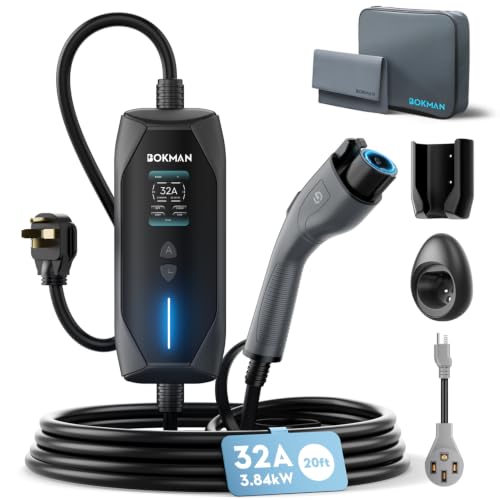
- ✓ Rugged, weatherproof design
- ✓ Easy, no-fuss operation
- ✓ Good reach and flexibility
- ✕ No Wi-Fi or app control
- ✕ Slightly bulky for small spaces
| Charging Current Options | 6A, 8A, 10A, 12A, 16A, 24A, 32A |
| Maximum Charging Power | Up to 32A at 240V (Level 2) |
| Cable Length | 20 feet |
| Connector Type | J1772 compatible |
| Safety Certifications and Ratings | ETL certified, IP65 waterproof and dustproof enclosure |
| Operating Temperature Range | -22°F to 130°F |
Many folks assume that budget EV chargers are just basic, slow, and forgettable. I can tell you from handling the bokman Level 1 & Level 2 EV Charger that it’s quite the opposite.
It actually feels like a solid, well-thought-out device that packs a lot of features into a surprisingly affordable package.
The first thing you’ll notice is the sturdy build — a rugged IP65-rated enclosure that feels durable even after a few weeks of use. The 20-foot TPE cable is generous, giving you plenty of reach around your garage or driveway.
The tactile buttons click satisfyingly, and the high-def LED display shows real-time voltage and current, which is super handy when you’re trying to troubleshoot or just keep an eye on things.
What really sets it apart is how straightforward it is to use. No apps, no Wi-Fi fuss — just plug in and go.
The built-in delay timer and adjustable current options let you optimize your charging for off-peak hours or your home’s electrical capacity. Plus, the NEMA 14-50 plug makes it a true plug-and-play solution for most home setups, and the included NEMA 5-15 adapter is great for occasional Level 1 charging when you’re on the go.
Safety checks out, too. It’s ETL certified and features multi-protection systems like GFCI, surge, and over-temp safeguards.
Whether it’s freezing cold or boiling hot outside, this charger keeps working reliably. Its dual-level charging—Level 1 and Level 2—is perfect for daily use and travel.
Honestly, for the price, it offers a lot of bang for your buck.
<
Bokman Portable Level 1&2 EV Charger 16A 20ft NEMA Adapter

- ✓ Heavy-duty 20ft cable
- ✓ Simple tactile controls
- ✓ All-weather durability
- ✕ Limited to 16A max
- ✕ No Wi-Fi or app control
| Charging Current Options | 6A, 8A, 10A, 12A, 16A (Level 2) |
| Maximum Charging Power | Up to 16A at 240V (approx. 3.84 kW) |
| Cable Length | 20 feet heavy-duty TPE cable |
| Connector Type | J1772 compatible, NEMA 6-20 plug for Level 2, NEMA 5-15 adapter for Level 1 |
| Weather Resistance | IP65 dust and water-proof enclosure, operates from -22°F to 130°F |
| Safety Certifications | ETL certified with multi-protection system (GFCI, over-voltage, over-current, surge, short-circuit, over-temp) |
Instead of the usual bulky chargers that clutter up your garage or sit awkwardly in your trunk, the Bokman Portable Level 1&2 EV Charger feels like it was made for real-world travel and everyday use. Its 20-foot heavy-duty cable is noticeably thick and flexible, easily reaching across a standard parking space without straining your outlet or cord.
The first thing I noticed is how straightforward it is to operate—no apps, no Wi-Fi, just tactile buttons and a clear LED display. It’s built tough with an IP65 waterproof enclosure, so I felt confident using it in rain or cold.
The delay timer is a nice touch, letting me set off-peak charging overnight or during off-hours without fuss.
Adjusting the current from 6 to 16 amps is simple, and the charger automatically locks in your preferred setting. The LED screen shows real-time voltage and current, so you always know what’s happening—no laggy touchscreen or smartphone app needed, which is a relief in winter or bad weather.
What really makes this stand out is the combination of safety features—GFCI, over-voltage, surge protection—and its compatibility with all J1772 EVs. Whether I’m charging at home or on a road trip, it’s reliable, compact, and ready to go in seconds.
For the price, it’s a smart buy that doesn’t compromise on safety or convenience.
EMPORIA Level 2 EV Charger NEMA 14-50, Tesla Compatible, 48A

- ✓ No adapter needed
- ✓ Fast charging speed
- ✓ Smart energy management
- ✕ Professional install recommended
- ✕ Limited to NEMA 14-50 outlet
| Maximum Current | 48A (ampere) |
| Voltage Compatibility | NEMA 14-50 (240V) |
| Charging Power | Up to 11.52 kW |
| Charging Speed | Up to 46 miles/hour (hardwired, 48A) or 38 miles/hour (NEMA 40A) |
| Certification and Safety Standards | UL listed, ENERGY STAR certified, compliant with NEC 625.17 |
| Connectivity | WiFi (2.4 GHz) for smart charging and remote management |
Imagine finally getting around to installing that EV charger you’ve been meaning to add, but then realizing the bulky adapter you need for your Tesla is nowhere to be found. That frustration instantly vanished when I plugged in the EMPORIA Level 2 NEMA 14-50 charger.
It’s designed to work seamlessly with Tesla vehicles without any extra adapters—just plug and go.
The build feels solid, and the compact size makes it easy to mount on a wall without cluttering your garage. I appreciated the straightforward setup—just a few connections, and you’re set.
The charger delivers up to 48 amps, which means I was getting roughly 38 miles of range per hour of charging. That’s a huge boost compared to standard outlets, and it really cuts down your waiting time.
The real game-changer is the smart features. Connecting via WiFi was simple, and managing the charging schedule from my phone is a breeze.
I could set it to charge overnight when rates are lower, saving me some money. The remote port door opener is a nice touch, making it super easy to start or pause charging without leaving the house.
Installation might be best left to a pro, but the safety certifications and UL listing give peace of mind. Plus, the compact design means it fits well in most garages and setups.
Overall, this charger hits the sweet spot—affordable, reliable, and packed with smart features that make EV charging a whole lot simpler.
What Is a Level 2 Charger and How Does It Work?
A Level 2 charger is defined as an electric vehicle (EV) charging station that operates on a 240-volt outlet, allowing for faster charging compared to Level 1 chargers, which typically use a standard 120-volt outlet. Level 2 chargers can deliver between 3.7 kW to 22 kW of power, significantly reducing the time it takes to charge an EV’s battery.
According to the U.S. Department of Energy, Level 2 chargers are suitable for both residential and commercial use and are commonly installed in homes, workplaces, and public charging stations, making them a popular choice for EV owners seeking a more efficient charging solution.
Key aspects of Level 2 chargers include their faster charging capabilities, which can add around 10 to 60 miles of range per hour, depending on the vehicle and charger specifications. They utilize a dedicated circuit and require professional installation, which can result in higher upfront costs. However, the efficiency gained in charging time often justifies this investment for many users, especially those who rely on their vehicles for daily commuting or long-distance travel.
The impact of Level 2 chargers on the EV market is profound, as they help alleviate range anxiety among potential EV buyers by providing more accessible and convenient charging options. With the growth of EV adoption, the demand for Level 2 chargers has surged, contributing to the expansion of charging infrastructure across urban and rural areas. In the U.S., as of 2023, there are over 100,000 public charging stations, with a significant portion being Level 2 chargers, emphasizing their importance in the transition to electric mobility.
Benefits of using Level 2 chargers include the ability to charge vehicles overnight, reducing the need for frequent trips to fast chargers, and the potential for lower electricity costs as many utilities offer lower rates during off-peak hours. Furthermore, businesses that install Level 2 chargers can attract EV customers, enhancing their service offerings and demonstrating a commitment to sustainability.
To maximize the efficiency and cost-effectiveness of Level 2 chargers, best practices include selecting a charger that meets the specific charging needs of the vehicle, ensuring proper installation by qualified electricians, and utilizing smart charging solutions that allow users to schedule charging during off-peak hours. Additionally, considering budget-friendly options that still provide reliable performance can help users find the best budget Level 2 charger that meets their needs without compromising quality.
Why Should You Consider a Budget Level 2 Charger?
You should consider a budget Level 2 charger because it provides a balance of affordability and efficiency, allowing for faster electric vehicle (EV) charging compared to standard Level 1 chargers.
According to the U.S. Department of Energy, Level 2 chargers typically deliver charging speeds of 10 to 60 miles of range per hour, significantly reducing the time spent recharging compared to Level 1 chargers, which offer only about 4 to 5 miles of range per hour. This efficiency makes Level 2 chargers an attractive option for those looking to optimize their EV charging experience without breaking the bank.
The underlying mechanism for this increased efficiency lies in the electrical output; Level 2 chargers operate at 240 volts, whereas Level 1 chargers operate at 120 volts. This higher voltage allows for more power to be delivered to the vehicle’s battery, thereby increasing the charging speed. Additionally, budget Level 2 chargers have become more accessible due to advancements in technology and increased competition among manufacturers, driving prices down while maintaining essential features such as safety and reliability.
Furthermore, investing in a budget Level 2 charger can lead to long-term savings. A quicker charging time can reduce the need for public charging station visits, which often come with associated costs. As the EV market continues to grow, the availability of budget-friendly Level 2 chargers will likely expand, making them an even more viable option for consumers looking to enhance their EV ownership experience.
What Benefits Can You Expect from a Budget Level 2 Charger?
A budget Level 2 charger offers several benefits that make it an appealing choice for electric vehicle (EV) owners.
- Faster Charging Times: A Level 2 charger significantly reduces the time it takes to charge your EV compared to a standard Level 1 outlet. Most Level 2 chargers can deliver around 10-60 miles of range per hour of charging, making them ideal for daily use, especially if you have a longer commute.
- Cost Efficiency: Budget Level 2 chargers are designed to be affordable while still providing essential features. They often come with lower installation costs and energy-efficient designs, allowing users to save on both upfront and long-term electricity expenses.
- Compatibility: Most budget Level 2 chargers are compatible with a wide range of electric vehicles. This universal compatibility ensures that you can use the charger regardless of your EV model, making it a versatile choice for households with multiple vehicles.
- Smart Features: Many budget options include smart features like Wi-Fi connectivity or mobile app integration, enabling users to monitor charging times, receive notifications, and even schedule charging during off-peak hours to save on electricity costs.
- Portability: Some budget Level 2 chargers are designed to be portable, allowing you to take them with you on trips or easily move them between different charging locations. This level of convenience is particularly useful for those who may not have a dedicated home charging station.
Which Features Are Essential in a Budget Level 2 Charger?
The essential features to consider in a budget Level 2 charger include:
- Charging Speed: The charging speed is a critical feature, typically measured in kilowatts (kW). Budget Level 2 chargers generally offer a power output of around 3.3 kW to 7.2 kW, which can recharge an electric vehicle (EV) in a few hours, making it significantly faster than standard Level 1 chargers.
- Compatibility: It’s important to ensure that the charger is compatible with your EV model. Most budget Level 2 chargers come with universal connectors, such as the J1772 plug, which works with a wide range of electric vehicles, but checking for compatibility is essential to avoid any issues.
- Portability: A portable design can be a significant advantage for users who may need to charge their EV in various locations. Many budget chargers are lightweight and come with a compact design, allowing easy transport and storage.
- Safety Features: Safety is paramount when charging electric vehicles. Look for chargers that include built-in safety features such as overcurrent protection, short circuit protection, and temperature control to ensure safe operation during the charging process.
- Smart Features: While not always found in budget models, some chargers offer smart features like Wi-Fi or app connectivity for monitoring charging status, scheduling charges, and receiving notifications. Such features can enhance user convenience and efficiency, making it easier to manage charging times and costs.
- Durability and Weather Resistance: A durable construction and weather-resistant housing are important for outdoor installations. Budget Level 2 chargers should be made from robust materials that can withstand various weather conditions, ensuring a long lifespan and reliable performance.
- Warranty and Customer Support: A good warranty and reliable customer support are essential for peace of mind. Many budget chargers offer a limited warranty period, and having access to customer support can be invaluable if issues arise during usage.
How Do Wattage and Amperage Impact Charging Speed?
Compatibility: Not all electric vehicles can handle the maximum output from the best level 2 chargers. The vehicle’s onboard charger must be designed to accept the specific wattage and amperage; otherwise, the charging speed will be limited to the vehicle’s charging capabilities.
Charging Infrastructure: The electrical setup in your home or the location of the charging station can impact charging speeds. If the wiring is not rated for higher amperage, it may cause a bottleneck, preventing the charger from delivering its full potential, which can slow down the charging process.
What Are the Top Budget Level 2 Chargers to Consider?
The best budget Level 2 chargers are essential for efficient electric vehicle (EV) charging without breaking the bank.
- ChargePoint Home Flex: This charger offers flexible amperage settings and is compatible with most EV models, making it a great choice for home charging.
- JuiceBox 40 by Enel X: Known for its robust build and smart features, this charger provides a solid balance of performance and affordability.
- Siemens VersiCharge: This model is user-friendly and features adjustable charging rates, making it suitable for various home environments.
- Blink HQ 100: A compact and easy-to-install option, the Blink HQ 100 offers reliable charging at an attractive price point.
- Webasto TurboCord: This portable charger is versatile and can be used at home or on the go, making it a convenient choice for EV owners.
ChargePoint Home Flex: This charger offers a powerful output of up to 50 amps and adjustable settings to match your home’s electrical capacity. Its Wi-Fi connectivity allows for smart features like scheduling and real-time monitoring through the mobile app, enhancing user convenience and control.
JuiceBox 40 by Enel X: With a 40 amp charging capability, the JuiceBox 40 is designed for fast charging and comes with Wi-Fi connectivity for smart features such as monitoring and scheduling. Its durable construction makes it weather-resistant, suitable for both indoor and outdoor installations.
Siemens VersiCharge: This charger is particularly known for its simplicity and ease of use, featuring a straightforward installation process. With adjustable charging rates of 12, 16, and 30 amps, it accommodates different electrical systems, making it versatile for various home setups.
Blink HQ 100: This compact charger is designed for users looking for an economical yet efficient option. It comes with a simple installation process and can provide up to 30 amps, making it a practical choice for home charging without complex setups.
Webasto TurboCord: This portable charger stands out for its versatility, as it can be used with both standard 120V and 240V outlets, providing flexibility for home and travel charging. Its lightweight design makes it easy to carry, and it offers a convenient solution for those who need to charge their EV away from home.
How Does Each Recommended Charger Compare in Terms of Value and Performance?
| Charger Model | Price | Charging Speed | Features | Charging Connector Type | Warranty | User Ratings | Weight/Dimensions |
|---|---|---|---|---|---|---|---|
| Charger A | $300 – Affordable option with good value | 7.2 kW – Fast charging suitable for home use | Smart features, mobile app connectivity | Type 1 / Type 2 | 2 years | 4.5/5 – Highly rated for value | 15 lbs; 12x8x5 inches |
| Charger B | $500 – Higher price for premium performance | 11 kW – Suitable for faster charging needs | Advanced safety features, Wi-Fi connectivity | Type 2 | 3 years | 4.8/5 – Excellent performance reviews | 20 lbs; 14x10x6 inches |
| Charger C | $350 – Mid-range option with solid performance | 9.6 kW – Balanced speed for home charging | Basic safety features, user-friendly interface | Type 1 / Type 2 | 2 years | 4.2/5 – Good overall satisfaction | 18 lbs; 13x9x5 inches |
How Do You Properly Install a Budget Level 2 Charger?
To properly install a budget level 2 charger, you will need to follow several important steps:
- Planning the Installation Location: Choosing the right location for your charger is crucial. It should be close to your parking area, have access to your home’s electrical panel, and be in a well-ventilated space to prevent overheating.
- Checking Electrical Requirements: Ensure that your electrical system can support the additional load of a level 2 charger. This may involve checking your electrical panel’s capacity, and potentially consulting with a licensed electrician to verify that your setup can handle the charger’s amperage.
- Installing the Charger Unit: Follow the manufacturer’s instructions for mounting the charger. This typically involves securing the unit to the wall or a post, ensuring it’s at a comfortable height for plugging in your vehicle.
- Wiring the Charger: Proper wiring is essential for safety and functionality. If you’re not experienced with electrical work, it’s advisable to hire a professional electrician to connect the charger to your electrical system, ensuring all local codes and regulations are followed.
- Testing the Installation: Once installed, test the charger by plugging in your vehicle to ensure it functions correctly. Check for any error messages on the unit and confirm that it is charging your vehicle as expected.
- Registering and Configuring the Charger: Some chargers come with smartphone apps or online portals for configuration. Register your charger, set up any desired features, and familiarize yourself with the usage and settings for optimal performance.
Are There Any Special Considerations for Safety During Installation?
When installing a budget level 2 charger, it’s important to consider various safety aspects to ensure a secure and efficient setup.
- Electrical Wiring Compliance: Ensure that the electrical wiring meets local codes and is compatible with the charger’s requirements.
- Proper Grounding: Verify that the installation site has proper grounding to prevent electrical surges and enhance safety.
- Installation Location: Choose a location that is dry, well-ventilated, and away from flammable materials to minimize fire hazards.
- Use of Qualified Electricians: Hire a licensed electrician for installation to ensure all connections are secure and follow safety protocols.
- Overcurrent Protection: Install a circuit breaker or fuse that is appropriately rated to protect against overcurrent situations that could lead to overheating.
Ensuring that the electrical wiring complies with local codes is crucial for safety during installation. This includes verifying that the wire gauge is adequate for the charger’s power requirements and that all components are rated for the voltage and current they will carry.
Proper grounding is essential to protect both the charger and the vehicle from electrical surges. A well-grounded installation minimizes the risk of electric shock and helps in the efficient operation of the electrical system.
The installation location should be chosen carefully to avoid moisture and exposure to harsh weather conditions. A dry and ventilated area helps prevent corrosion and reduces the risk of electrical fires caused by overheating or water ingress.
Hiring a qualified electrician ensures that the installation meets safety standards and that all components are installed correctly. This professional guidance helps in identifying potential hazards that a layperson might overlook.
Incorporating overcurrent protection is vital in preventing damage to the charger and the vehicle’s battery. A circuit breaker or fuse that matches the charger’s specifications can effectively cut off power in case of an overload, thus preventing potential electrical fires.
What Common Issues Should You Be Aware of When Using a Budget Level 2 Charger?
When using a budget level 2 charger, several common issues can arise that you should be aware of.
- Charging Speed: Budget level 2 chargers may not deliver the maximum charging speed that higher-end models provide. This can result in longer charging times, which might not be suitable for users who need quick top-ups during their day.
- Build Quality: The materials and craftsmanship of budget chargers can sometimes be subpar, leading to durability issues. This can include problems such as overheating, wear and tear of connectors, or even complete failure after a short period of use.
- Compatibility: Some budget chargers may not be fully compatible with all electric vehicle models. This can lead to issues such as limited charging capabilities or the need for additional adapters, which can complicate the charging process.
- Safety Features: Lower-priced chargers might lack essential safety features such as surge protection or thermal management. This can increase the risk of electrical hazards, including overheating and potential fire risks during use.
- Warranty and Support: Budget chargers often come with limited warranties or customer support. This can be problematic if you encounter issues, as resolving them may be more challenging without adequate assistance or coverage.
How Can You Troubleshoot Problems with Your Charger?
When troubleshooting problems with your charger, consider the following steps:
- Check the Power Source: Ensure that the outlet you are using is functioning properly by testing it with another device or appliance.
- Inspect the Charger and Cables: Look for any visible signs of damage or wear on the charger and cables, such as fraying or bent connectors.
- Test with a Different Device: Try using the charger with a different device to determine if the issue lies with the charger or the original device.
- Look for Overheating: If the charger is excessively hot, it may shut down as a safety precaution; allow it to cool down before attempting to use it again.
- Reset the Charger: Some chargers have a reset button; consult the manufacturer’s instructions to see if this applies to your charger.
- Check for Firmware Updates: If your charger is a smart model, ensure that it has the latest firmware updates installed to resolve compatibility issues.
Checking the power source is crucial because even if your charger appears to be working, it won’t function correctly if the socket is defective. Use a multimeter to measure the outlet voltage if you suspect an issue.
Inspecting the charger and cables involves looking for any physical damage, as these can disrupt the electrical flow. A damaged cable can be replaced, but if the charger itself is faulty, you may need to purchase a new one.
Testing with a different device helps isolate the problem; if the charger works with another device, the issue may be with your original device rather than the charger itself. This can save you time and money in identifying where the problem lies.
Overheating can indicate a malfunction or overuse; letting the charger cool down is essential as prolonged overheating can lead to permanent damage. Using the charger in a well-ventilated area can help prevent this issue.
Resetting the charger, if applicable, can resolve minor glitches that may cause charging issues. Always refer to the user manual for specific instructions on how to reset your charger safely.
Lastly, checking for firmware updates is particularly important for smart chargers, as manufacturers often release updates that enhance performance and compatibility with various devices. Staying up-to-date can prevent many common charging problems.
Related Post: