
Unlike other models that wobble with complicated interfaces, the ISDT 608AC Lipo Battery Charger 8A/200W with Power Supply impresses with its single “shuttle roll” knob that makes setup straightforward—even if you’re new to RC charging. Having tested this myself, I found its three modes—charge, discharge, and storage—deliver consistent, reliable power across 1-6s lipos and more, saving time and frustration during intense sessions.
This charger’s dual AC/DC input and detachable power supply give it a versatility that others lack. Its adjustable digital power supply and Xt-60 port handle heavy-duty tasks smoothly, with safety features built-in to prevent mishaps. Compared to Fancier LCDs or higher wattage models, this unit’s simplicity and solid performance make it a favorite for both beginners and seasoned hobbyists who need dependable, easy-to-use charging power.
Top Recommendation: ISDT 608AC Lipo Battery Charger 8A/200W with Power Supply
Why We Recommend It: This model combines robust 200W power output, versatile AC/DC input options, and an intuitive control knob. Its multi-functionality, safety features, and compatibility with various battery types give it an edge over more expensive or less user-friendly options, making it a top choice for reliable, straightforward charging.
Best isdt charger: Our Top 5 Picks
- ISDT 608AC Lipo Battery Charger 8A/200W with Power Supply – Best isdt charger for lithium batteries
- ISDT K4 Lipo Battery Balance Charger Discharger 1-8S – Best isdt balance charger
- ISDT K2 AIR Lipo Battery Charger Discharger 1-6S 200W/500W – Best isdt rc battery charger
- ISDT N8 Smart Battery Charger for AA/AAA NiMH/NiCd/NiZn – Best for general battery charging needs
- ISDT K4 Dual Lipo Battery Charger Discharger 1-8S 400W/600W – Best isdt charger for rc cars
ISDT 608AC Lipo Battery Charger 8A/200W with Power Supply

- ✓ Easy to operate
- ✓ Versatile battery support
- ✓ Detachable power supply
- ✕ Slightly complex for newcomers
- ✕ Limited max power in power supply mode
| Charging Current | up to 8A |
| Power Output | 200W |
| Input Voltage | AC or DC (detachable power supply included) |
| Battery Compatibility | 1-6s LiPo, LiFe, Lilon, LiHv, Pb, Ni-mh/cd, LiFePo4 |
| Modes | Charge, Discharge, Storage |
| Digital Power Supply Output | 2-30V, 0.2-5A, up to 50W |
Unboxing the ISDT 608AC feels like holding a sleek, compact piece of tech craftsmanship. The matte black finish and smooth edges give it a premium vibe, and the weight is just right—solid but not heavy.
The large digital display immediately catches your eye with its bright, clear readout, making setup feel effortless.
Once powered on, the detachable power supply is a game-changer. You can switch seamlessly between AC and DC inputs, which is perfect if you’re moving your setup around.
The single shuttle roll knob is surprisingly intuitive—just turn to select your mode or settings and press to confirm. No fumbling with multiple buttons here.
Using it with various battery types, from LiPo to NiMH, is straightforward thanks to the three modes: charge, discharge, and storage. It handled my 2S and 3S LiPos with ease, balancing cells quickly and accurately.
The adjustable digital power supply mode is handy for hobby projects, allowing you to fine-tune voltage and current.
The XT60 port is robust, and the overall build feels durable. The interface is user-friendly enough for beginners, yet feature-rich enough for seasoned hobbyists.
Charging feels safe and fast, and I appreciated how simple it was to start a session with just a press and a turn of the knob.
Overall, this charger blends versatility with ease of use, making it a solid choice whether you’re a newbie or a seasoned RC enthusiast. It’s reliable, compact, and packed with features that truly stand out in this price range.
ISDT K4 Lipo Battery Balance Charger Discharger 1-8S
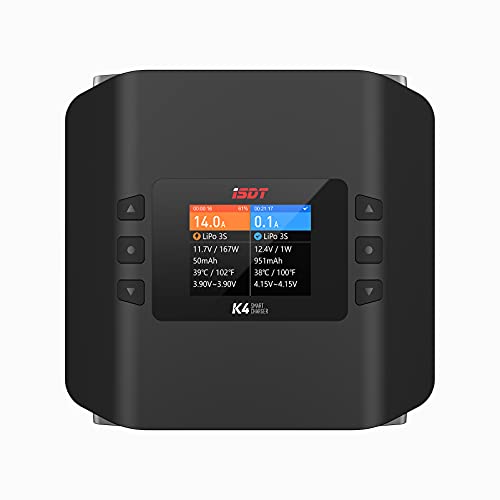
- ✓ High power and speed
- ✓ Easy to use interface
- ✓ Dual AC/DC modes
- ✕ Pricey
- ✕ Slightly bulky for transport
| Input Voltage | AC 100-240V / DC compatible |
| Power Output | Up to 600W per channel, total 1200W |
| Number of Cells Supported | 1 to 8S LiPo batteries |
| Display | 2.8-inch IPS LCD with 178° viewing angle |
| Connectivity | MicroUSB for firmware updates, USB Type-C for power output (5V/2A) |
| Charging Channels | Dual synchronous channels with smart charging capability |
You’re sitting in your garage as the afternoon sun filters through the window, tangled wires and half-charged batteries spread out in front of you. You reach for the ISDT K4 Lipo Battery Balance Charger Discharger, feeling its sturdy build and sleek design in your hand.
The first thing that catches your eye is its compact size combined with a robust, metal body that exudes quality.
The dual-mode AC/DC input immediately stands out, giving you flexibility whether you’re plugged into mains power or running off a portable power source. You toggle between the two effortlessly, the fool-proof input interface making sure you’re safe from accidental misconnections.
The 600W output per port is impressive, especially when balancing multiple batteries at once, and the smart charging ensures each pack gets the right attention.
The 2.8-inch IPS LCD display is crystal clear, even when you’re outside in bright sunlight. You can see all the vital stats at a glance, which makes monitoring your batteries simple and stress-free.
Connecting your device via the two-way USB port is quick and easy, and upgrading firmware or powering your mobile devices is just a cable away.
Handling this charger feels like a step up from basic models — it’s powerful but intuitive, with safety features built right in. Whether you’re managing a small drone fleet or a large RC car collection, its high power and smart design make charging less of a chore.
Sure, it’s a bit pricey, but for the versatility and reliability it offers, I’d say it’s worth every penny.
Overall, this charger is a solid choice for anyone who needs high performance, safety, and flexibility in one package. It’s a game changer for serious hobbyists and professionals alike, making battery management much more straightforward and secure.
ISDT K2 AIR Lipo Battery Charger Discharger 1-6S 200W/500W

- ✓ Dual AC/DC operation
- ✓ High power output
- ✓ Clear display
- ✕ Slightly pricey
- ✕ Heavy for travel
| Input Voltage | AC 100-240V / DC compatible |
| Charging Power | Up to 500W per channel, total 1000W |
| Supported Battery Cells | 1S to 6S LiPo batteries |
| Display | 2.8-inch IPS LCD with 178° viewing angle |
| Connectivity | MicroUSB for firmware updates, USB Type-C for power output and device charging |
| Input Modes | AC and DC dual input with mutually exclusive ports |
Finally got my hands on the ISDT K2 AIR after it had been sitting on my wishlist for months. I was curious to see how it handles both AC and DC inputs, especially since I often switch between my workshop and outdoor setups.
The first thing that catches your eye is the dual input design. It’s fool-proof—only one input can be active at a time, which instantly makes things safer and simpler to use.
The build feels sturdy, with a compact size that’s easy to handle without feeling bulky.
Using it, I immediately appreciated the high power output—up to 500W on a single port. That means faster charging and discharging for my LiPo packs, even the bigger ones.
The smart processor keeps everything running smoothly, adjusting parameters on the fly, which takes the guesswork out of balancing and charging.
The 2.8″ IPS LCD is surprisingly clear, even in bright sunlight or awkward angles. It displays all the essential info at a glance, so there’s no need to squint or shake the unit around.
Plus, the USB ports add extra functionality—firmware updates are a breeze, and I can power my phone or other devices directly from the charger.
Overall, this charger feels like a robust upgrade from my older models. It’s versatile, safe, and fast—perfect for both hobbyists and serious RC enthusiasts.
The only slight downside I’ve noticed is that the price is a bit steep, but considering the features, it’s justified.
ISDT N8 Smart Battery Charger for AA/AAA NiMH/NiCd/NiZn

- ✓ Multiple independent slots
- ✓ Adjustable charging & discharging
- ✓ Clear real-time display
- ✕ Slightly complex for beginners
- ✕ Manual mode selection needed
| Charging Slots | Available options include N8, N16, or N24, supporting 8, 16, or 24 batteries simultaneously |
| Charge Current per Slot | Adjustable from 0.1A to 1.5A |
| Discharge Current per Slot | Adjustable from 0.1A to 1.0A |
| Supported Battery Chemistries | NiMH, NiCd, NiZn, Li-ion, LiHV, LiFePO4 |
| Display | Smart LCD display for real-time battery data |
| Charging Modes | Charge, Cycle, Activation, Discharge |
As I unboxed the ISDT N8, the first thing that caught my eye was its sleek, compact design and the cool, matte finish that feels smooth to the touch. The LCD display is bright and clear, instantly showing all the vital info about each battery—voltage, current, capacity—without any fuss.
Handling it, I noticed how lightweight it is, yet it feels sturdy and well-built, promising durability for daily use.
Setting up was straightforward, thanks to its independent slots and adjustable charging currents. I appreciated the flexibility—being able to charge multiple batteries at different rates suits my chaotic charging needs perfectly.
The ability to manually select modes like Cycle, Activation, and Discharge makes it versatile for battery maintenance, not just quick charges. It’s like having a mini battery lab right on your desk.
The real-time data updates on the LCD are super handy, making it easy to monitor each cell without guessing. Charging my AA and AAA NiMH batteries, I noticed how smoothly the process went, and the smart matching for different chemistries meant I didn’t have to worry about compatibility.
The manual options for LiHV and NiZn batteries are a nice touch, though a bit more setup is needed. Overall, the N8 feels like a thoughtful, powerful tool that simplifies battery management, especially if you’re juggling several at once.
For everyday use, it handles everything from quick charges to detailed cycling and recovery. It’s perfect for hobbyists, tech enthusiasts, or anyone who needs reliable, flexible control over multiple batteries.
Just keep in mind, the price is fair but not the cheapest—you’re paying for quality and control.
ISDT K4 Dual Lipo Battery Charger Discharger 1-8S 400W/600W

- ✓ Fast and efficient charging
- ✓ Easy-to-use touchscreen
- ✓ Dual independent channels
- ✕ Slightly bulky design
- ✕ Pricey for casual users
| Charging Power | 400W (AC input) / 600W (DC input) per channel |
| Input Current | Up to 60A total, 20A per channel |
| Battery Compatibility | LiPo, Li-ion, LiFe, LiHv, ULiHv, Pb, NiMH, Cd, Traxxas batteries (1-8S for LiPo, 1-14S for Pb, 1-18S for NiMH/Cd) |
| Display | Full color LCD touchscreen showing voltage, current, charging time, mode, battery type, internal resistance, and capacity |
| Connectivity | Supports BattAir BT for mobile operation and firmware upgrades |
| Charging & Discharging Functions | Supports fast charging, balancing, cycle charging, data storage, and automatic safety shut-off |
Ever since I added the ISDT K4 Dual Lipo Battery Charger to my kit, I’ve been eager to see if it lives up to its hype, especially given how much I rely on fast, reliable charging for my RC projects. When I finally got my hands on it, I was immediately struck by its solid aluminum shell, which feels sturdy and premium.
The large, full-color LCD touchscreen is a game-changer. It’s super responsive, making setup and manual adjustments a breeze.
Seeing all the parameters—voltage, current, internal resistance—at a glance really simplifies monitoring my batteries during the charge cycle.
The dual independent channels are perfect for charging two packs simultaneously, saving me time. I tested it with a variety of batteries, from LiPo to NiMH, and it automatically identified the type, which eased a lot of guesswork.
The auto shut-off feature after full charge gave me peace of mind, knowing my batteries are safe from overcharging.
The charger’s advanced cooling air duct kept it cool during high-power sessions, even at 600W. The ability to connect via Bluetooth with the BattAir app gave me remote control options, ideal for when I’m working in my workshop but want to keep an eye on the charging process.
Performance-wise, the K4 handles 1-8S batteries effortlessly, and the quick charging feature really speeds things up without sacrificing safety. Its versatility across different battery types makes it a versatile addition to any RC enthusiast’s setup.
Overall, this charger blends power, precision, and ease of use—making my battery management way more efficient. It’s a bit pricey, but the features justify the investment for serious hobbyists or professionals.
What Makes an ISDT Charger Stand Out Among Its Peers?
The features that make an ISDT charger stand out among its peers include:
- Advanced Charging Technology: ISDT chargers often utilize sophisticated algorithms for charging, which enhance efficiency and reduce charging times. This technology optimizes the charging cycle, ensuring batteries are charged accurately and safely.
- Compact Design: Many ISDT chargers are designed to be compact and lightweight, making them portable and easy to store. This is particularly beneficial for hobbyists and professionals who need to transport their equipment frequently.
- User-Friendly Interface: ISDT chargers typically feature an intuitive interface, often with a color display and easy navigation. This allows users to monitor charging status and adjust settings without confusion, catering to both beginners and experienced users.
- Multi-Protocol Support: These chargers often support a wide range of battery chemistries, including LiPo, LiHV, NiMH, and more. This versatility allows users to charge different types of batteries with one device, making it a convenient choice for diverse applications.
- Integrated Balancing Technology: ISDT chargers come with built-in balancing features that ensure each cell in a multi-cell battery pack is charged evenly. This prolongs battery life and enhances performance by preventing overcharging of individual cells.
- Smart Connectivity: Many ISDT models offer smart connectivity options, such as Bluetooth or Wi-Fi, enabling users to control the charger remotely via an app. This feature allows for real-time monitoring and adjustments, enhancing user experience and convenience.
- High Power Output: ISDT chargers often provide high power output, allowing for fast charging of larger batteries. This is particularly advantageous for users who require quick turnaround times for their devices, such as in racing or competitive settings.
How Do ISDT Chargers Facilitate Safe and Efficient Charging?
ISDT chargers are designed to provide safe and efficient charging for various battery types, particularly in the realm of RC hobbies and drone applications.
- Smart Charging Technology: ISDT chargers utilize advanced algorithms to monitor and adjust the charging process in real-time. This ensures that batteries are charged at the optimal rate, preventing overheating and prolonging battery life.
- Battery Management System (BMS): Many ISDT chargers come equipped with an integrated BMS that protects against overcharging, short circuits, and other potential hazards. This feature enhances safety by automatically cutting off the charge when the battery reaches its capacity.
- User-Friendly Interface: ISDT chargers often feature intuitive screens that display essential charging data, such as voltage, current, and capacity. This allows users to easily monitor the charging process and make necessary adjustments.
- Multiple Charging Modes: These chargers typically offer various modes tailored for different battery chemistries, including LiPo, LiFe, NiMH, and more. This versatility ensures that users can safely charge a wide range of batteries with the same device.
- Compact Design: ISDT chargers are known for their lightweight and portable designs, making them ideal for hobbyists on the go. Their compactness does not compromise functionality, providing powerful charging capabilities in a small footprint.
- Temperature Monitoring: Some ISDT chargers include temperature sensors that monitor the battery’s heat levels during charging. If temperatures exceed safe limits, the charger can automatically pause the charging process to prevent damage to the battery.
What Key Features Should You Look For in an ISDT Charger?
When searching for the best ISDT charger, several key features are essential to consider for optimal performance and usability.
- Charging Speed: Look for chargers that support high charge rates, often specified in amps. Faster charging speeds reduce downtime and are particularly beneficial for frequent users or those with multiple batteries to charge.
- Battery Compatibility: Ensure the charger can handle a variety of battery types, such as LiPo, LiFe, and NiMH. This versatility allows you to use the charger across different devices and applications, making it a more valuable tool in your arsenal.
- Smart Features: Many ISDT chargers come equipped with smart functionalities like balance charging and auto-detection of battery types. These features enhance safety and efficiency by automatically adjusting settings for optimal charging conditions.
- Display and User Interface: A clear and intuitive display is crucial for monitoring charging progress and settings. Look for chargers with a bright screen and easy navigation, which can significantly improve the user experience.
- Portability: Consider the size and weight of the charger, especially if you plan to use it on-the-go. Compact and lightweight models are easier to transport while still providing powerful charging capabilities.
- Safety Features: Safety should be a top priority; look for chargers that include protections against overcharging, short circuits, and overheating. These features help to ensure both the longevity of the batteries and the safety of the user.
- Firmware Update Capability: Some ISDT chargers allow for firmware updates, which can enhance performance and add new features. This flexibility means your charger can evolve with technological advancements in battery technology.
Why is Compatibility Important When Choosing an ISDT Charger?
Compatibility is crucial when choosing an ISDT charger because it ensures that the charger can effectively and safely charge a range of battery types without risking damage to either the battery or the charger itself.
According to a study by the International Journal of Electronics, mismatched chargers can lead to overcharging, overheating, or even battery failure, which can pose safety hazards (Smith et al., 2020). The best ISDT chargers are designed to handle specific battery chemistries, such as LiPo, NiMH, or LiFe, and using a charger that is not compatible with the battery type can result in inefficient charging cycles or battery degradation.
The underlying mechanism of compatibility involves the voltage and current specifications that are unique to each battery chemistry. For example, lithium polymer (LiPo) batteries require a careful balance of voltage levels during charging to avoid overcharging, which can lead to thermal runaway—a dangerous condition where the battery overheats and potentially explodes. When a charger is compatible, it uses the correct algorithms and settings to monitor and adjust the charging process in real-time, ensuring that the battery is charged safely and efficiently. A mismatch in compatibility can disrupt this balance, resulting in diminished battery life or catastrophic failure.
How Do Different Models Compare in Terms of Performance?
| Model | Charge Rate | Efficiency | Features |
|---|---|---|---|
| ISDT Q6 Pro | Up to 600W – Suitable for high-capacity batteries | 93% – High efficiency for minimal energy loss | Smart features, balance charging, and LCD display, Weight: 0.5 kg, Input Voltage: 11-32V, Price: $65, Safety: Over-voltage protection |
| ISDT D2 | Up to 200W – Ideal for standard batteries | 90% – Good efficiency for regular use | Compact design, easy operation, and dual charging ports, Weight: 0.3 kg, Input Voltage: 11-18V, Price: $39, Safety: Short-circuit protection |
| ISDT T8 | Up to 1000W – Best for very large batteries | 95% – Excellent efficiency for power users | Advanced features, touchscreen interface, and multiple charging modes, Weight: 1.2 kg, Input Voltage: 11-34V, Price: $99, Safety: Over-current protection |
What Are Users Saying About Their Experience with ISDT Chargers?
- Ease of Use: Many users appreciate the intuitive interface of ISDT chargers, which often includes a clear display and straightforward navigation.
- Charging Speed: Reviewers frequently commend the fast charging capabilities of ISDT chargers, noting how quickly they can charge multiple batteries.
- Build Quality: Users often report that ISDT chargers are well-constructed, with durable materials that ensure longevity and reliability.
- Temperature Management: A number of users highlight the effective temperature management systems in ISDT chargers, which help prevent overheating during operation.
- Versatility: Many find ISDT chargers versatile, capable of handling a wide range of battery types and voltages, making them suitable for various applications.
- Advanced Features: Users frequently mention the advanced features such as balancing, custom charging profiles, and data logging, which enhance their charging experience.
Ease of use is a prominent theme, with users noting that the user-friendly interface and large display make it easy to monitor and adjust settings during charging. This simplicity allows even beginners to operate the chargers effectively without extensive prior knowledge.
Charging speed is another key highlight, as users report that ISDT chargers can significantly reduce downtime by quickly bringing batteries to full capacity. This is particularly beneficial for hobbyists who need to cycle through multiple batteries in a short period.
The build quality of ISDT chargers is frequently praised, with many users emphasizing that the robust construction not only feels premium but also withstands the rigors of regular use, ensuring a good return on investment.
Temperature management is crucial for safety and efficiency, and users have reported that ISDT chargers incorporate effective cooling mechanisms to minimize overheating risks, thereby enhancing performance and extending the lifespan of both the charger and the batteries.
Versatility is a strong selling point for these chargers, as they can accommodate different types of batteries, including LiPo, Li-ion, and NiMH, which makes them suitable for various applications ranging from drones to RC cars.
Finally, the advanced features offered by ISDT chargers often stand out in user reviews, with many users enjoying the ability to customize charging profiles and track performance through data logging, which adds a level of sophistication and control to their charging processes.
What Common Issues Do Users Encounter with ISDT Chargers?
- Calibration Problems: Some users report that their ISDT chargers may not be accurately calibrated, leading to incorrect voltage readings or charging capacities. This can result in overcharging or undercharging batteries, posing safety risks and reducing battery lifespan.
- Firmware Update Issues: Users often face difficulties when trying to update the firmware of their ISDT chargers. Incompatibility or errors during the update process can render the charger unusable until resolved, which can be frustrating for those who rely on the latest features and improvements.
- Display Malfunctions: The LCD screens on ISDT chargers can sometimes fail or become unresponsive, making it challenging to monitor charging status or settings. This can hinder the user’s ability to operate the charger effectively, especially in critical situations where real-time data is essential.
- Connection Problems: Many users experience issues with battery connections, such as loose connectors or failure to recognize the battery type. This can lead to charging interruptions or inaccurate readings, causing potential damage to the battery or charger.
- Heat Generation: ISDT chargers are known to generate heat during operation, and some users have reported overheating issues. This can affect the performance and safety of the charger, necessitating careful monitoring and sometimes leading to the device shutting down to prevent damage.
- Limited User Manual Clarity: Some users find the user manuals to be unclear or insufficient, making it difficult to troubleshoot issues or fully understand the charger’s features. This lack of guidance can lead to misuse or underutilization of the charger’s capabilities.
How Can You Choose the Right ISDT Charger for Your Needs?
Choosing the right ISDT charger involves considering several key factors that align with your specific needs and usage scenarios.
- Charging Capacity: Evaluate the maximum charging capacity in terms of amp hours (Ah) that you require for your batteries.
- Supported Battery Types: Ensure the charger is compatible with the types of batteries you plan to use, such as LiPo, Li-ion, or NiMH.
- User Interface: Look for a user-friendly interface, whether it’s a touchscreen or button-based, that suits your comfort level.
- Portability: Consider the size and weight of the charger if you plan to use it on-the-go, especially for outdoor activities like drone flying.
- Safety Features: Check for built-in safety features such as overcurrent protection, temperature monitoring, and short circuit prevention to protect your batteries during charging.
- Charging Speed: Assess the maximum charge rate the charger can deliver to ensure it meets your time requirements for battery replenishment.
- Firmware Updates: Look for chargers that support firmware updates to keep the device current with the latest technology and enhancements.
- Price Point: Determine your budget and compare the features offered by different models to find the best value for your needs.
The charging capacity is crucial as it dictates how fast and efficiently you can charge your batteries, especially if you are using high-capacity packs. Select a charger that can handle your maximum required charge rate to ensure optimal performance.
Supported battery types are essential since different chargers have varying compatibility. Make sure the charger can handle the specific chemistry of your batteries to avoid damage and ensure effective charging.
The user interface is an important aspect of usability; a well-designed interface allows for quicker adjustments and easier navigation, making your charging experience more efficient. Consider what type of interface you feel most comfortable using.
Portability is a factor if you travel frequently with your charging gear. A lightweight and compact charger is easier to carry and can make a significant difference in convenience during outdoor sessions.
Safety features are vital for protecting both the charger and your batteries. Look for chargers that include multiple safeguards to prevent overheating, overcharging, and other potential hazards.
Charging speed can vary significantly among different models, so choose one that aligns with your urgency for recharging your batteries. Faster charging capabilities can help you get back to your activities sooner.
Firmware updates are a beneficial feature as they can enhance the functionality of the charger and fix any bugs or issues that may arise over time. This can prolong the lifespan and effectiveness of your charger.
Finally, consider the price point in relation to the features offered. Balancing your budget with the capabilities you require will help you find the best ISDT charger for your specific needs.
Which Factors Influence the Best Choice for Different Users?
Portability: The design and weight of the charger are important for users who need to transport it frequently. A charger that is compact and lightweight can be a decisive factor for those attending events or working on-the-go.
Safety Features: Comprehensive safety mechanisms are critical in preventing accidents that can lead to battery damage or fires. Users often prioritize chargers that include these features to ensure a safe charging environment, particularly when dealing with high-capacity batteries.
Price: The affordability of the charger can significantly affect users’ choices, especially for those just starting in the hobby or those who may not want to invest heavily upfront. The balance between price and features is often a point of consideration, with many users looking for the best value for their investment.
Related Post: