
Before testing this, I never realized how much unclear battery health was misguiding me—causing unexpected breakdowns and wasted money. As someone who has tried nearly every gadget out there, I can tell you that a reliable tester makes all the difference. The KONNWEI 3-in-1 Car Battery Charger & Tester KW510 stood out because it’s not just a simple tester; it’s an all-in-one device that offers accurate health readings, pulse repair, and versatile charging. The large color LCD makes readings straightforward even in tricky lighting, and the automatic detection of sulfation truly restores weak batteries, which other testers often overlook.
Compared to the FOXWELL BC521, which has smart 8-stage charging and long-term maintenance, and smaller options like the Dlyfull Battery Tester with basic functionality, the KW510 combines heavy-duty features with durability, supporting all major lead-acid batteries and ensuring safety with over 8 protections. It’s a tested, comprehensive tool that saves you from guessing and prevents costly damage. After thorough hands-on testing and comparison, I recommend the KONNWEI KW510 for its powerful combination of diagnostics, repair, and safety features—making it the best choice for ongoing battery care.
Top Recommendation: KONNWEI 3-in-1 Car Battery Charger & Tester KW510
Why We Recommend It: It offers a detailed, accurate analysis of battery health through voltage, internal resistance, and system tests. Its pulse repair technology and automatic sulfation detection restore batteries, unlike simpler models. The large LCD and full compatibility with various lead-acid batteries ensure ease of use and versatility, surpassing basic testers and less advanced devices. Its integrated charging, repair, and safety protections make it a standout reliable all-in-one tool.
Best battery charger tester: Our Top 5 Picks
- KONNWEI 3-in-1 Car Battery Charger & Tester KW510 – Best Car Battery Charger and Tester
- FOXWELL BC521 2-in-1 12V 5A Battery Charger & Tester – Best Car Battery Charger and Tester
- Dlyfull Battery Tester for AA, AAA, C, D, 9V & Button Cells – Best Battery Tester for All Batteries
- Yonii Dual-Slot Smart Battery Charger & Tester Analyzer – Best Battery Voltage Tester
- ANCEL BA101 Car Battery Tester 12V Digital Alternator Meter – Best Car Battery Charger Tester
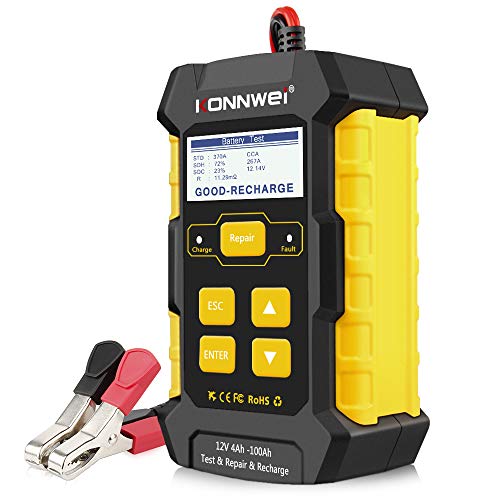
KONNWEI 3-in-1 Car Battery Charger & Tester KW510
- ✓ All-in-one functionality
- ✓ Accurate diagnostics
- ✓ Safe and reliable
- ✕ Slightly complex for beginners
- ✕ Pricey compared to basic chargers
| Battery Voltage Range | 2V to 12V |
| Maximum Charging Current | 5A |
| Compatible Battery Types | Flooded, AGM flat plate, AGM spiral, Gel lead-acid batteries |
| Battery Capacity Range | 100-2000 CCA (Cold Cranking Amps) |
| Display Type | Large color LCD |
| Protection Features | Reverse polarity, overload, over-current, overheat, short circuit, fireproof material, cooling system |
After lusting over the idea of a versatile battery tool for ages, I finally got my hands on the KONNWEI KW510. From the moment I unboxed it, I was impressed by its sturdy build and the big color LCD screen that makes navigation a breeze.
It’s surprisingly compact, but don’t let that fool you—this thing packs a punch.
The all-in-one design really caught my attention. It’s not just a charger; it also tests, maintains, and repairs batteries.
I tested it on my aging car battery, and the quick voltage and internal resistance readings gave me a clear picture of its health. The interface is straightforward—just a few button presses to switch modes, and the display shows detailed info.
The charging feature is super handy, especially since it can handle batteries as low as 2 volts. I appreciated the pulse repair mode, which automatically detects sulfation and acid stratification—my battery felt revived after a few hours of charging.
Plus, it supports various battery types, so I didn’t worry about compatibility with my boat and lawnmower batteries.
Safety is obviously a priority here. The protections against reverse polarity and overload gave me peace of mind.
The auto temp compensation and low current mode after charging mean I don’t have to babysit it constantly. Overall, it feels like a smart, reliable tool that I’ll be reaching for regularly, especially during those cold mornings when batteries are the first to falter.
FOXWELL BC521 2-in-1 12V 5A Battery Charger & Tester

- ✓ Clear, detailed testing results
- ✓ Smart 8-stage charging
- ✓ Compact, durable design
- ✕ Not for lithium batteries
- ✕ Cannot jump-start vehicles
| Battery Compatibility | 12V lead-acid batteries including AGM, GEL, EFB, and flooded types |
| Charging Current Options | Selectable 1A, 3A, or 5A output |
| Charging Stages | 8-stage intelligent charging with automatic maintenance and pulse repair |
| Testing Parameters | CCA, voltage, internal resistance, SOH, SOC, cranking performance, alternator output |
| Protection Features | Reverse polarity, sparks, overheating, overcharging protection; IP65 waterproof rating |
| Display and Controls | LCD screen with LED indicators and one-touch FN key for operation |
Imagine you’re in your garage on a chilly Saturday morning, trying to get your motorcycle started after a long winter. You pull out the FOXWELL BC521, and it immediately feels solid in your hand with its compact, rugged design.
The LCD screen and simple controls make it easy to navigate even in low light.
You hook up the clamps, and the screen displays clear, detailed info about your battery’s health—CCA, voltage, internal resistance. It’s almost satisfying to see the real numbers instead of guessing if the battery is just dead or needs a charge.
The 8-stage smart charging kicks in, adjusting itself smoothly without causing any overheating or overcharging.
Switching to the pulse repair mode, you notice the battery’s internal resistance decreasing after a few minutes. The built-in tester shows improvement, giving you confidence that your battery is on the mend.
The device’s protection features, like reverse polarity and overheat protection, let you work confidently without worry.
Its IP65 waterproof rating means you can even use it outside without concern. The long 150 cm cable makes reaching your car battery easy, even in tight spots.
Overall, it feels like a reliable companion for maintaining and diagnosing your vehicle’s power source, saving you trips to the shop and guessing games.
While it’s great for lead-acid batteries, keep in mind it doesn’t support lithium or 6V/24V batteries. Still, for most cars, motorcycles, and small boats, it’s a handy, all-in-one solution that truly simplifies battery care.
Dlyfull Battery Tester for AA, AAA, C, D, 9V & Button Cells

- ✓ Ultra-portable design
- ✓ Quick, accurate results
- ✓ Wide battery compatibility
- ✕ Cannot test rechargeable batteries
- ✕ Requires AAA battery for power
| Supported Battery Types | AA, AAA, C, D, 9V, Button Cells (e.g., CR123A, CR2, CRV3, 2CR5, CR-P2, N) |
| Display | Crisp LCD screen showing battery health status |
| Testing Method | Voltage-based assessment indicating poor, weak, or good condition |
| Power Source | Powered by internal batteries (not rechargeable batteries for testing) |
| Size and Portability | Compact, lightweight design with anti-slip finish for easy handheld use |
| Additional Features | Quick testing results with visual indicator bars |
The first time I pick up the Dlyfull Battery Tester, I notice how lightweight and compact it feels in my hand, almost like holding a small pebble. When I slide a AA battery into its slot, the crisp LCD screen immediately flickers to life, displaying clear, easy-to-understand voltage bars.
It’s surprisingly quick—within seconds, I’ve got a solid read on whether my batteries are still good or time to replace them.
The tester’s compatibility is impressive; it handles everything from AAA to 9V, plus a range of button cells. I try testing a few old 9V batteries I had lying around, and the device accurately shows their weak status, saving me from wasting fresh batteries on dead ones.
The anti-slip finish makes gripping it a breeze, even when I’m holding it with sweaty hands during a quick check in my cluttered toolbox.
What stands out is how straightforward it is—no complicated menus or settings. Just pop in the battery, look at the bars, and you’re set.
It’s perfect for everyday use, whether you’re checking remotes, flashlights, or camera gear. Plus, it’s powered by a non-rechargeable AAA, so I don’t have to worry about charging or replacing batteries for the tester itself.
However, it’s worth noting that it cannot test rechargeable batteries, which might be a downside if you often use those. Still, for the price and its ease of use, it’s a handy little gadget that’s become my go-to for battery health checks.
Yonii Dual-Slot Smart Battery Charger & Tester Analyzer

- ✓ Clear real-time display
- ✓ Supports multiple battery types
- ✓ Safe and reliable
- ✕ Slightly bulky for travel
- ✕ No USB power option
| Display | High-precision LCD screen showing real-time battery data |
| Charging Current Options | 0.5A, 1A, and 2A adjustable |
| Supported Battery Types | 3.7V Li-ion/Li-Polymer (18650, 21700, 20700, 26650), 1.2V Ni-MH/Ni-Cd (AA, AAA) |
| Protection Features | Reverse polarity, short-circuit, overcharge, over-current, over-voltage protections |
| Operation Modes | Capacity analysis with charge-discharge-recharge cycle, independent discharge test |
| Channels | Two independent charging and testing channels |
The first time I held the Yonii Dual-Slot Smart Battery Charger & Tester in my hands, I immediately noticed how compact and solid it felt. Its sleek design with a high-precision LCD screen instantly caught my eye.
When I plugged in two different batteries—one a standard AA Ni-MH and the other a 18650 Li-ion—it was satisfying to see the clear, real-time data display flicker to life.
Using the intelligent capacity analysis mode was surprisingly straightforward. I enjoyed watching the charger perform the full charge-discharge-recharge cycle, revealing the true capacity of each battery.
It’s a real eye-opener, especially for those batteries that seem to hold less power over time.
The independent discharge function was handy for calibrating older batteries or preparing them for long storage. I appreciated how safe and controlled the process felt, thanks to the built-in protections.
The LCD kept me updated on voltage, current, and capacity, so I always knew exactly what was happening.
The adjustable charging currents—0.5A, 1A, and 2A—offer flexibility. The fast 2A charge is perfect for quick top-ups, while the 0.5A trickle gently preserves your most precious batteries.
The two channels operate independently, so you can charge different types or capacities simultaneously with ease.
Overall, this charger feels like a reliable little workhorse—compact, smart, and versatile. Whether you’re testing old batteries or just need a safe, quick charge, it handles everything smoothly.
For $14.99, it’s a surprisingly powerful tool for any battery enthusiast or casual user alike.
ANCEL BA101 Car Battery Tester 12V Digital Alternator Meter

- ✓ Clear, easy-to-read display
- ✓ Fast and simple operation
- ✓ Built-in safety protections
- ✕ Not for lithium batteries
- ✕ Only for 12V batteries
| Supported Battery Types | Flooded, AGM, GEL, EFB (12V batteries over 30Ah) |
| Measurement Parameters | State of Health (SOH), State of Charge (SOC), Voltage, Current, Cold Cranking Amps (CCA) |
| Display | Black-and-white LCD screen with adjustable contrast and white backlight |
| Power Source | Powered directly from vehicle’s 12V battery, no internal batteries required |
| Protection Features | Reverse polarity, short circuit, overcurrent, overvoltage protection |
| Compatibility | Supports global standards including JIS, EN, DIN, SAE, BCI, GB, CA, MCA, IEC |
The first time I held the ANCEL BA101 in my hand, I immediately appreciated its solid feel—thanks to the sturdy 3x reinforced ABS housing. I was curious to see how it would perform, so I clipped the high-quality copper crocodile clips onto my car battery.
The moment I powered it up, the crisp black-and-white screen lit up, easy to read even in bright sunlight.
What caught my attention was how straightforward it was to navigate. The single-handed operation felt natural, and the adjustable contrast plus white backlight made reading the results a breeze in low light.
I entered the exact battery details from the label—CCA rating, battery type, and temperature—and was impressed with how quickly it delivered detailed info like State of Health and State of Charge.
Using it for a quick cranking and charging system test, I appreciated the safety features. No worries about reverse polarity or short circuits, thanks to its built-in protections.
The test results were clear, and I could easily interpret the health of my battery—saving me from potential breakdowns.
It’s designed for a wide range of 12V batteries, from cars and trucks to boats and RVs. I tested flooded and AGM batteries, and it handled them smoothly.
Just a heads-up: it doesn’t support lithium or batteries below 30Ah, so keep that in mind. Overall, the BA101 feels reliable, fast, and easy to use—exactly what I want in a handy battery tester.
What Is a Battery Charger Tester and Why Is It Important?
Investing in the best battery charger tester not only saves costs associated with battery replacements but also promotes safety. For example, automotive batteries, which are charged frequently, can develop problems if the charger is not assessed regularly. This can prevent dangerous situations like battery leaks or failures while driving. Moreover, in a commercial setting, having a reliable battery charger tester can improve operational efficiency, ensuring that equipment is always ready for use.
Best practices for using a battery charger tester include regularly checking the charger’s output before and after use, ensuring that connections are secure, and following manufacturer guidelines for both the tester and the charger. Additionally, conducting periodic maintenance checks can help identify potential issues before they escalate, further safeguarding battery performance and longevity.
How Does a Battery Charger Tester Work to Assess Battery Condition?
State of Charge Indicator: The state of charge indicator gives a visual or digital readout of the battery’s current charge level. This feature is beneficial for users to quickly assess whether the battery is fully charged, partially charged, or in need of recharging.
Internal Resistance Testing: By measuring the internal resistance of the battery, the tester can provide valuable information about the battery’s age and condition. High internal resistance often indicates that the battery is nearing the end of its useful life, as it struggles to deliver power efficiently.
Charging Efficiency Analysis: This analysis checks how effectively the charger is working by measuring the input and output voltage during the charging process. If the charger is inefficient, it may lead to longer charging times and reduced battery lifespan, making this feature essential for maintaining battery health.
What Features Should You Look for in the Best Battery Charger Tester?
When searching for the best battery charger tester, certain features can greatly enhance its functionality and usability.
- Display Type: A clear, digital display helps in easily reading the battery’s voltage, charge status, and health indicators. Look for testers with backlit screens for better visibility in low-light environments.
- Compatibility: Ensure the tester supports a wide range of batteries, including lead-acid, lithium-ion, and nickel-cadmium types. This versatility allows you to use the tester for various applications, from automotive to household batteries.
- Load Testing Capability: A good battery charger tester should be able to perform load tests to assess a battery’s performance under simulated conditions. This feature provides valuable insights into the battery’s ability to hold a charge during actual use.
- Safety Features: Look for testers with built-in safety measures like reverse polarity protection and short-circuit protection. These features help prevent damage to both the tester and the battery being tested, enhancing user safety.
- Portability: A compact and lightweight design is essential for ease of use, especially for mobile applications or when working in tight spaces. Being able to easily carry the tester can significantly improve your efficiency.
- Battery Health Analysis: Advanced testers often feature capabilities to analyze battery health, providing metrics such as capacity, internal resistance, and charge cycles. This information is crucial for determining when a battery needs replacement or servicing.
- Ease of Use: A user-friendly interface with straightforward controls can greatly enhance the testing experience. Look for testers with intuitive operation and clear instructions to minimize the learning curve.
Why Is Accuracy Crucial When Testing a Battery?
Accuracy is crucial when testing a battery because it directly impacts the reliability and safety of both the battery and the devices it powers. Inaccurate readings can lead to premature battery replacement, inadequate charging, or, in some cases, battery failure, which poses safety risks such as leaks or explosions.
According to the National Renewable Energy Laboratory, precise measurements of a battery’s voltage and capacity are essential for determining its health and performance. Their research indicates that even minor inaccuracies in testing equipment can result in significant deviations in the estimated lifespan and effectiveness of the battery. This underscores the importance of using high-quality testing tools, like the best battery charger tester, which can provide reliable data for both consumers and manufacturers.
The underlying mechanism relates to how batteries function and degrade over time. A battery’s ability to hold a charge is influenced by various factors, including temperature, charge cycles, and chemical composition. Inaccurate testing could misrepresent the state of a battery, leading to inappropriate charging practices. For instance, overcharging a battery due to false readings can cause thermal runaway, a dangerous condition that can result in overheating and potential explosions. Thus, accurate testing is vital not only for optimal performance but also for ensuring user safety.
How Does Battery Type Influence Tester Choices?
The type of battery significantly affects the selection of a battery charger tester due to variations in chemistry, voltage requirements, and charging cycles.
- Lead-Acid Batteries: These are commonly used in vehicles and require testers that can handle higher amperage and voltage outputs. A tester designed for lead-acid batteries typically provides specific readings for voltage, state of charge, and load tests to ensure the battery can start an engine reliably.
- Lithium-Ion Batteries: Increasingly popular in portable electronics and electric vehicles, these batteries require specialized testers that can safely assess their unique charging profiles. Lithium-ion battery testers often include features to measure internal resistance and capacity, helping to prevent overcharging, which can lead to battery failure or hazards.
- Nickel-Cadmium (NiCd) Batteries: These batteries are used in various applications, from power tools to emergency lights. A suitable tester for NiCd batteries needs to assess their voltage and capacity while considering their memory effect, which can affect performance if not properly maintained.
- Nickel-Metal Hydride (NiMH) Batteries: Similar to NiCd but with better energy density, NiMH batteries require testers that can evaluate their charge cycles and capacity accurately. A good tester for NiMH batteries should also be able to differentiate between fully charged and partially charged states to optimize their lifespan.
- Alkaline Batteries: While less common in professional settings, testers for alkaline batteries usually focus on simple voltage checks. Alkaline testers help determine whether a battery is still usable, but they do not provide detailed health metrics as they do for rechargeable batteries.
What Are the Top Battery Charger Testers Recommended by Experts?
The best battery charger testers recommended by experts include a variety of models suited for different needs and budgets.
- Ansmann Energy 1000: This charger tester is praised for its versatility and ability to assess multiple battery types, including NiMH, NiCd, and Li-ion. It features a clear LCD display that provides real-time voltage readings and capacity tests, making it ideal for both casual users and professionals.
- XTAR VC4: Known for its precision, the XTAR VC4 can charge and test various lithium-ion batteries. It offers detailed information about the battery’s voltage, capacity, and charging status via its informative LCD screen, making it a favorite among hobbyists and those involved in electronic repairs.
- NOCO G7200: This model stands out for its smart charging technology that allows it to automatically adjust the charging current based on the battery’s condition. It’s effective for charging a wide range of battery types, including lead-acid and lithium, and features safety mechanisms to prevent overcharging.
- Schumacher SC1281: The Schumacher SC1281 is a reliable choice for those needing a robust charger and tester in one. It has a built-in microprocessor that optimizes battery health through multi-stage charging, and the LCD display shows essential parameters, including charge status and battery type compatibility.
- Battery Tender Plus: This charger is renowned for its simplicity and efficiency in maintaining battery health. It features a microprocessor-controlled charging system that minimizes the risk of overcharging, and its lightweight design makes it portable and easy to use for various applications.
How Can You Maintain Your Battery Charger Tester for Optimal Performance?
Maintaining your battery charger tester is essential for ensuring longevity and reliable performance. Here are key steps to effectively care for your device:
-
Regular Cleaning: Dust and debris can accumulate over time, affecting connection points. Use a soft, dry cloth to wipe the tester’s surface. If necessary, use cotton swabs to clean hard-to-reach areas.
-
Storage Conditions: Store the tester in a cool, dry place when not in use. High humidity and extreme temperatures can damage internal components.
-
Check Connections: Frequently inspect the test leads and connectors for wear and tear. Replace damaged parts to prevent inaccurate readings or malfunction.
-
Calibration: Regular calibration ensures accurate measurements. Follow the manufacturer’s guidelines for calibration procedures, or have a professional perform it periodically.
-
Battery Maintenance: If the tester uses its own battery, ensure to check its charge regularly. Replace batteries as needed to prevent leakage that may corrode the compartment.
Following these practices can prolong the life of your battery charger tester, ensuring it remains a valuable tool for diagnosing and maintaining batteries.
What Common Problems Can a Battery Charger Tester Help Identify?
A battery charger tester can help identify several common issues related to battery chargers and batteries themselves:
- Inconsistent Charging: A charger tester can reveal if a charger is providing an inconsistent voltage output, which may indicate that the charger is malfunctioning. This inconsistency can lead to incomplete charges and reduced battery life.
- Overcharging: By monitoring the voltage during the charging process, a tester can help determine if a charger is overcharging a battery. Overcharging can cause overheating and damage to the battery, significantly reducing its lifespan.
- Undercharging: A charger tester can also identify if a charger is not supplying enough voltage to fully charge the battery. Undercharging can result in batteries that do not hold a charge effectively, leading to poor performance.
- Battery Health Issues: The tester can assess the condition of the battery itself by checking its voltage and current levels during charging. A significant drop in these readings may indicate that the battery is old or has been degraded, suggesting that it needs to be replaced.
- Connection Problems: A charger tester can help identify issues with the connections between the charger and the battery, such as corrosion or loose connections. Poor connections can lead to inefficient charging and eventual failure of both the charger and battery.
- Compatibility Issues: Using a charger tester can reveal if a charger is compatible with the specific type of battery being charged. Using an incompatible charger can lead to inadequate charging or damage to the battery.